
UK design guidance: Dimensions shown are typical architectural reference values and may vary by manufacturer, project requirements and applicable local building regulations. Always verify requirements for your specific project.
UK bed and mattress sizes follow a well-established, standard set of widths and lengths. Knowing these is the starting point for planning any bedroom layout — see Bedroom Layouts and Bedroom Planning Clearances for how a given bed size fits into a complete room.
Common UK bed sizes
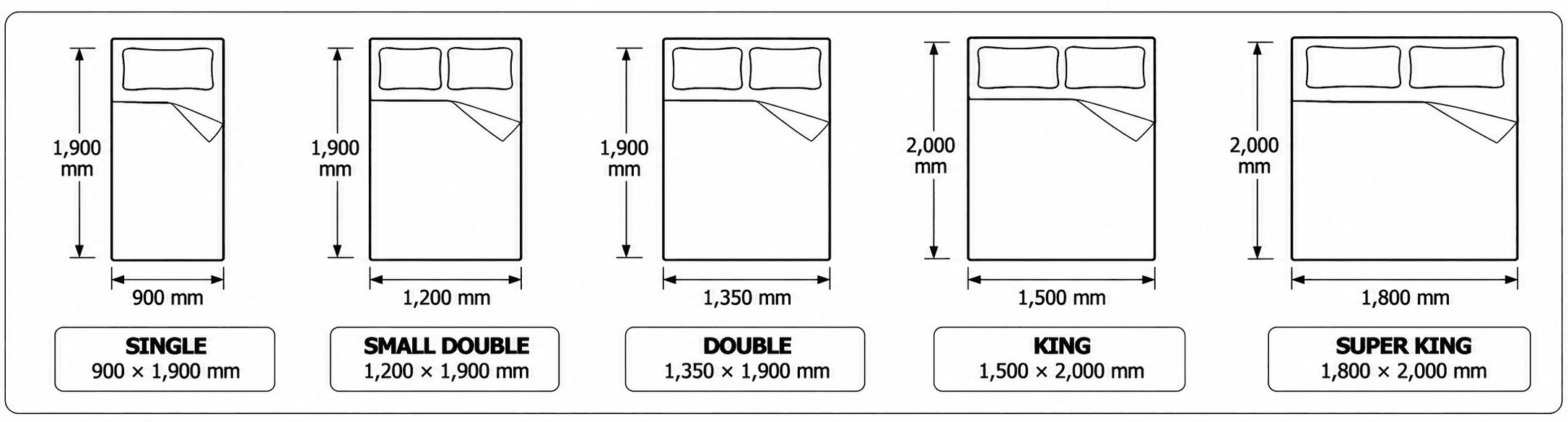
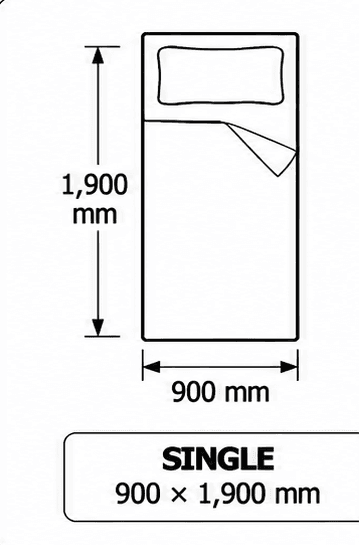
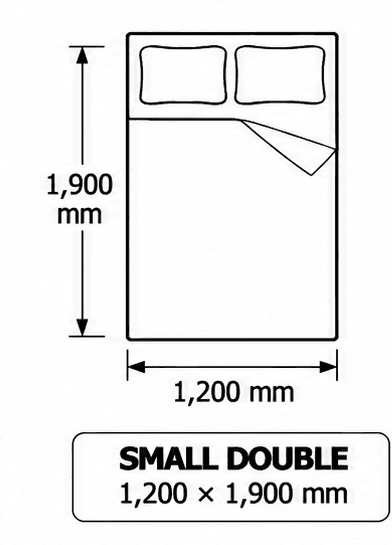
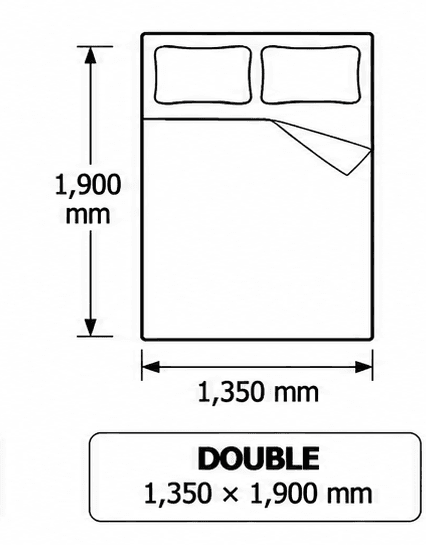
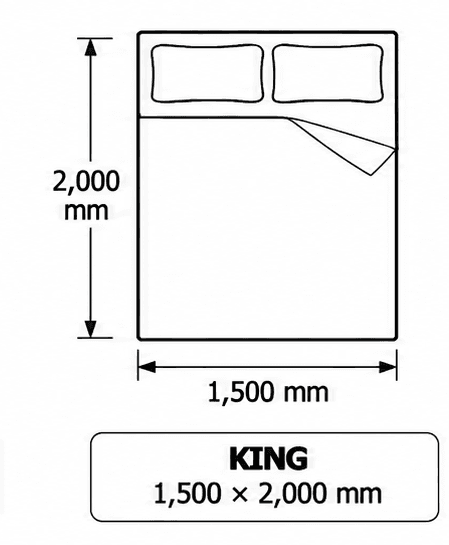
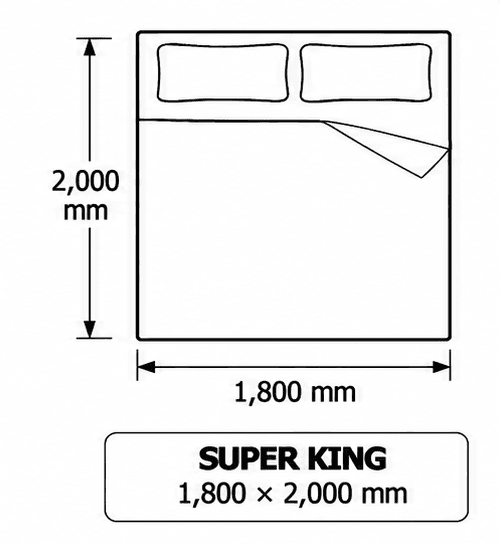
| Dimension | Value |
|---|---|
| Single — width | 900 mm (35.4 in) |
| Small double — width | 1200 mm (47.2 in) |
| Double — width | 1350 mm (53.1 in) |
| King — width | 1500 mm (59.1 in) |
| Super king — width | 1800 mm (70.9 in) |
| Single / small double / double — length | 1900 mm (74.8 in) |
| King / super king — length | 2000 mm (78.7 in) |
- Single — 900 × 1,900 mm. Standard for a single sleeper, child's room or guest room.
- Small double — 1,200 × 1,900 mm. A compromise size for a couple in a smaller room, or a generous single room.
- Double — 1,350 × 1,900 mm. The most common size for a main bedroom.
- King — 1,500 × 2,000 mm. A popular upgrade from double, needing a noticeably larger room.
- Super king — 1,800 × 2,000 mm. The largest standard UK size, needing the most floor area of the five.
Mattress size versus bed frame size
The figures above are mattress sizes, which is the UK industry's standard reference point — mattresses, fitted sheets and duvets are all sold against this exact set of dimensions. A bed frame is a different measurement: it has to be at least as large as the mattress it holds, but headboards, side rails, footboards and the frame's own material thickness typically add some margin on top.
This matters for planning because it's the frame's footprint, not the mattress's, that actually occupies floor space in a room:
- A divan base (the mattress sits directly on an upholstered box base) usually stays closest to the mattress's own footprint, sometimes with a separate headboard fixed to the wall rather than the base itself.
- A bedstead with rails (a frame with a headboard and footboard connected by side rails) commonly needs some additional depth at the head end for the headboard, and can add width where the rails sit outside the mattress edge.
- Ottoman and storage beds follow the mattress width and length closely but add noticeably more visual bulk at the sides and foot.
There's no single standard "frame allowance" the way there is for mattress sizes — it varies by manufacturer and style. For an accurate room layout, check the specific frame's own stated dimensions rather than assuming it matches the mattress size exactly; where only the mattress size is known, allowing roughly 50–100 mm extra on each side and 100–150 mm at the head end is a reasonable planning margin until the actual frame is confirmed.
A common planning mistake
Sizing a room around the mattress dimensions alone, then finding the actual bed frame (plus its headboard) doesn't leave the bedside clearance intended — see Bedroom Planning Clearances for the clearances that should be measured from the frame's actual edge, not the mattress underneath it.
Frequently asked questions
What's the difference between a double and a small double bed?
150 mm of width — a small double is 1,200 mm wide versus a double's 1,350 mm. Both are 1,900 mm long. A small double is a common choice where a full double won't comfortably fit.
Are UK and US/European bed sizes the same?
No — US and European bed sizes use different standard widths and lengths to the UK figures shown here. Always confirm the specific market's sizing when specifying furniture or bedding from outside the UK.
How much room clearance does a bed size need beyond its own footprint?
See Bedroom Planning Clearances for the recommended space around a bed (bedside access, foot-of-bed circulation and main circulation), measured from the bed frame's actual edge rather than the mattress size shown here.
Is a bed frame always the same size as its mattress?
No — a frame has to be at least as large as its mattress, but headboards, rails and the frame's own material add some margin that varies by manufacturer and style. Check the specific frame's stated dimensions for an accurate room layout rather than assuming it matches the mattress size.
Sources & references
- Which? — UK bed and mattress size guide (independent consumer guidance; the UK does not have a single formal regulatory standard for bed/mattress sizes — these are a widely-used trade convention followed consistently across UK bedding and furniture retailers).
- Bed frame dimensions vary by manufacturer and style — always confirm against the specific product.


